 Login for Polarin

How is Lightstorm Changing India’s Network Infrastructure?
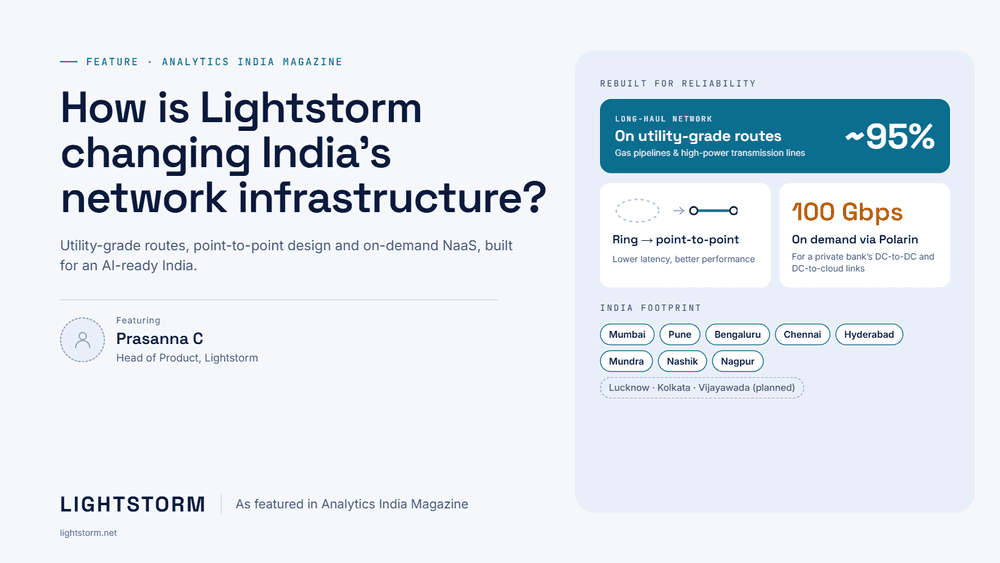
Analytics India Magazine · Featuring Prasanna C, Head of Product, Lightstorm
India’s networks have long been unreliable, and some global enterprises have avoided routing traffic through the country as a result. Analytics India Magazine looks at how Lightstorm set out to change that.
The biggest step was rebuilding the network’s foundations. Lightstorm moved about 95% of its long-haul network onto utility-grade infrastructure, such as gas pipelines and high-power transmission lines, which sharply cuts outages from cable cuts. It also replaced traditional ring-based designs with point-to-point links for better performance and lower latency. Prasanna C notes that building a reliable core was the hardest part in India, whereas developed markets like Singapore and Europe focus more on optimisation and customer experience.
On top of this sits Polarin, Lightstorm’s Network-as-a-Service platform for hybrid and multi-cloud connectivity, data centre interconnection and internet exchange access. Traditional telecom services can take months to buy and set up; Polarin delivers connectivity on demand. In one example, a private Indian bank moving to new data centres used Polarin to get a secure private network with up to 100 Gbps of bandwidth, with protected diverse paths on utility-grade fibre.
Lightstorm’s Indian network covers Mumbai, Pune, Bengaluru, Chennai, Hyderabad, Mundra, Nashik and Nagpur, with Lucknow, Kolkata and Vijayawada planned. Beyond India, it operates from the Middle East to the US West Coast and is expanding in Indonesia and Thailand. Its automated, API-driven platform can connect Indian data centres to locations worldwide, often within minutes. As enterprises adopt AI at scale, the article argues, this kind of robust network infrastructure will become essential.
Source: Analytics India Magazine