
Dawn Of An AI Era
"The best way to predict the future is to invent it."
Alan Kay's famous observation has guided generations of technologists. Yet history suggests something equally profound: inventing the future is only half the challenge. The other half is building the infrastructure that allows it to scale.
We rarely recognize transformational moments while we're living through them. The Industrial Revolution did not begin with a declaration, nor did the internet arrive with universal consensus that it would redefine commerce, communication and society. Their significance became obvious only in hindsight, once the supporting infrastructure had quietly reshaped the world around them.
Artificial Intelligence feels remarkably similar. What began as a research discipline has, in just a few years, become one of the defining technologies of our time. AI is no longer confined to laboratories or experimental projects; it is writing software, accelerating scientific discovery, assisting doctors, reshaping customer experiences and changing how businesses make decisions. Every week seems to bring another breakthrough, another model or another capability that pushes the boundaries of what machines can accomplish.
What makes this moment different is not just AI's capability, but its pace. Previous technological revolutions unfolded over decades, giving societies, industries and institutions time to adapt. AI is compressing those timelines into months. Capabilities that seemed impossible a year ago are becoming commonplace, forcing organizations to rethink strategies far more frequently than they ever have before.
Unsurprisingly, much of the conversation has centered on models, algorithms and compute. They are, after all, the visible face of the AI revolution. But history teaches us that the technologies we remember are rarely the only reason revolutions succeed.
The steam engine transformed industry, but without railways it could not have connected markets or enabled large-scale manufacturing. Electricity changed modern civilization, but only because power grids carried it beyond the laboratory. The internet reshaped the global economy, yet it was fibre networks, subsea cables, data centers and cloud infrastructure that allowed billions of people to experience it simultaneously.
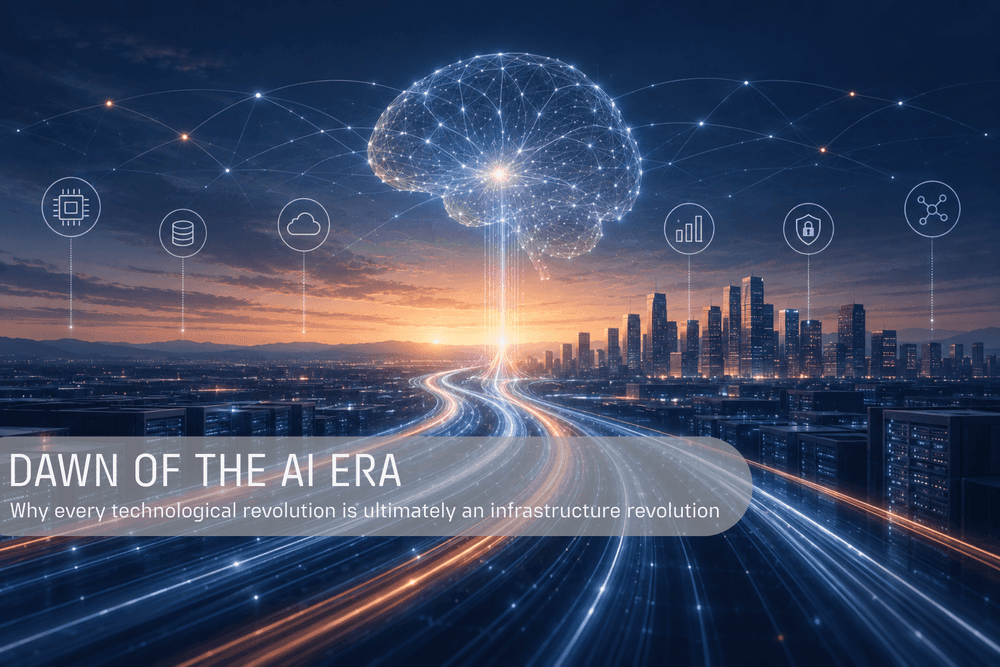
Every technological revolution has ultimately become an infrastructure revolution. AI will be no different.
At Lightstorm, we see this shift unfolding every day. Conversations that once centered on bandwidth or cloud connectivity are increasingly centered on AI readiness, data gravity and how enterprises can move intelligence securely across distributed environments. The questions may have changed, but the underlying lesson has not: every leap in technology ultimately depends on the infrastructure that supports it.
The Beast Has Been Built
It is tempting to think of today's AI systems as simply another generation of software. They are not.
Large language models and foundation models represent a fundamental shift in how machines interact with information. Rather than following explicitly programmed instructions, they generate responses, reason through problems, synthesize knowledge and increasingly perform tasks that once relied exclusively on human expertise. More remarkable still is the speed at which these capabilities continue to evolve.
Only a few years ago, AI-generated content was largely viewed as an interesting novelty. Today, enterprises are using AI to assist with software development, customer engagement, operational planning, cybersecurity and scientific research. The conversation has rapidly shifted from "Can AI do this?" to "How do we responsibly integrate AI into everything we do?"
This is more than the arrival of another digital tool. AI represents a new layer of intelligence that will increasingly sit across every application, every workflow and every industry. Much like electricity before it, AI is unlikely to remain a standalone technology. Instead, it will become an enabling capability embedded so deeply into business processes that organizations will eventually stop referring to "AI projects" altogether. AI will simply become part of how work gets done.
That shift carries implications that extend far beyond the models themselves. Every interaction with an AI system involves enormous volumes of data moving between users, applications, cloud platforms and increasingly distributed computing environments. Every AI-powered recommendation depends on information flowing securely, reliably and at extraordinary speed between multiple systems.
Intelligence, in other words, does not exist in isolation. It depends on connection. And as AI adoption accelerates, that dependence will only grow stronger.
Beyond Compute
Much of the conversation around AI has understandably centered on compute. Graphics Processing Units (GPUs), specialized accelerators and hyperscale data centers have become synonymous with the AI revolution, and for good reason. Without compute, there is no model to train and no intelligence to deploy.
Yet focusing exclusively on compute risks overlooking another reality: AI is fundamentally a data movement problem.
Training foundation models requires enormous datasets drawn from multiple sources. Enterprise AI applications continuously exchange information between cloud environments, private infrastructure and users spread across regions. As inference increasingly moves closer to where decisions need to be made, organizations are also witnessing a dramatic increase in east-west traffic between data centers, rather than simply north-south traffic between users and applications.
In other words, AI is not confined to a single location. It is inherently distributed. Data, models and applications are constantly moving across cloud platforms, enterprise environments and edge locations, creating digital ecosystems that are significantly more dynamic than those built for previous generations of enterprise software.
This shift is particularly evident in conversations with enterprises embarking on AI initiatives. While the discussion often begins with models, GPUs and applications, it quickly turns to practical questions around data movement, latency, cloud interconnection and resilience. Organizations are discovering that AI readiness is as much an infrastructure challenge as it is a technology challenge.
As AI becomes embedded within day-to-day operations, organizations will discover that moving intelligence efficiently is becoming just as important as creating it. This is where the conversation naturally shifts beyond models and GPUs towards something less visible, but equally consequential: the infrastructure that connects them.
Every AI Conversation Eventually Becomes an Infrastructure Conversation
The first wave of enterprise AI has largely focused on applications. Boards are discussing AI copilots, CIOs are evaluating foundation models, and business leaders are exploring use cases across software development, customer service, cybersecurity and analytics. Those conversations are necessary, but they inevitably lead to a more fundamental question: can the underlying infrastructure keep pace?
At Lightstorm, we've observed that this is increasingly where AI strategies succeed or stall. The organizations making the fastest progress are not necessarily those experimenting with the most models, but those building networks capable of connecting data, compute and cloud environments without introducing complexity or bottlenecks.
That question reflects a broader shift in how networks are expected to operate. For years, enterprise connectivity was designed around relatively predictable traffic patterns. Employees accessed applications hosted in corporate data centers, branch offices connected back to headquarters, and even the transition to cloud largely followed well-understood communication paths.
AI is rewriting those assumptions.
Today's AI workloads are dynamic, distributed and continuously exchanging information between multiple environments. As a result, the network is no longer simply responsible for transporting data; it is becoming an active participant in how intelligence is created, distributed and consumed.
The implications extend well beyond bandwidth. Latency influences the responsiveness of AI applications. Network resilience determines whether mission-critical services remain continuously available. End-to-end visibility becomes essential as organizations seek to understand how data, applications and models interact across increasingly complex environments. Above all, agility becomes a competitive advantage. AI is evolving at a pace that few organizations have experienced before, and infrastructure must evolve just as quickly if it is to support that change rather than constrain it.
History offers an interesting parallel. The internet did not become transformative simply because websites existed. It became transformative because reliable, high-capacity connectivity made those services universally accessible. AI is following a remarkably similar trajectory. While breakthroughs in models and applications may capture the headlines, long-term value will ultimately be determined by the infrastructure that allows those breakthroughs to scale across enterprises, industries and economies.
For network providers, this represents a fundamental shift in responsibility. Networks are no longer expected to simply connect locations; they are increasingly expected to interconnect intelligence itself—linking clouds, data centers, enterprise environments and AI workloads into a resilient digital fabric capable of supporting the next generation of applications.
Sooner or later, every AI conversation becomes an infrastructure conversation.
Building the Foundations of the AI Era
The AI race is often framed as a competition to build the most capable model or develop the next breakthrough application. While those innovations will undoubtedly shape the future, they represent only one part of a much larger story.
Every AI application, regardless of where it runs or what it does, depends on an ecosystem that can move data securely, reliably and at scale. Governments investing in sovereign AI are simultaneously investing in digital infrastructure. Enterprises deploying AI are rethinking how data moves between cloud environments, how workloads are distributed across data centers, and how intelligence can be delivered closer to where decisions need to be made. The common thread across these initiatives is not simply AI—it is the infrastructure that enables AI to function.
For enterprises, this represents a significant shift in priorities. The competitive advantage created by AI will not come from experimentation alone, but from the ability to operationalize intelligence across the organization. That requires more than access to powerful models. It requires a digital foundation capable of connecting applications, data and compute seamlessly across increasingly distributed environments. Organizations that continue to view connectivity as operational overhead may find it becoming a bottleneck. Those that recognize it as strategic infrastructure will be better positioned to adapt as AI continues to evolve.
This shift is already changing expectations of the network itself. Connectivity is no longer measured solely by bandwidth or uptime. Increasingly, it will be judged by its ability to support low-latency AI inference, enable high-volume data movement, connect distributed cloud environments and provide the resilience required for business-critical AI applications.
At Lightstorm, we believe this marks the next evolution of digital infrastructure. Networks are no longer expected to simply move traffic between locations. They are increasingly expected to interconnect intelligence—connecting AI workloads, cloud platforms, data centers and enterprise applications into a resilient digital fabric that enables innovation at scale.
History suggests that this is neither surprising nor unique. Every major technological leap has depended on an enabling layer that quietly made progress possible. Railways unlocked the Industrial Revolution. Power grids enabled electrification. Fiber networks transformed the internet from a niche technology into a global platform for innovation and commerce.
The AI era will follow the same pattern.
The breakthroughs will capture headlines. New models will continue to redefine what machines can achieve. Yet the long-term impact of AI will ultimately depend on something far less visible: the infrastructure that connects data, compute and people with the speed, resilience and trust that modern digital ecosystems demand.
That is perhaps the most important lesson history offers. We often remember revolutions for the technologies that inspired them. We rarely remember the infrastructure that made them possible.
Yet without that foundation, no revolution has ever truly scaled.
At Lightstorm, this belief shapes how we think about the future. Building AI-ready infrastructure is not simply about delivering more bandwidth or connecting more locations. It is about creating networks that can adapt to the changing demands of AI, enabling enterprises to move data securely, scale intelligently and innovate without constraint. As the AI era unfolds, we believe the organizations that invest in this foundation today will be the ones best positioned to define what comes next.