 Login for Polarin

What Is Network-as-a-Service (NaaS) and Why Enterprises Are Moving Towards It
Think of how quickly cloud computing transformed the way enterprises handle compute and storage, allowing them to spin up, scale, and shut down at will. Yet, most networks still operate like they’re stuck in another decade with long provisioning timelines, fixed bandwidth, and endless tickets for even the smallest change.
As enterprises double down on hybrid and multi-cloud strategies, this gap becomes harder to ignore. Data and applications now flow across multiple clouds and data centers, but connectivity remains stubbornly static. To back this up, over 90% of enterprises use cloud services, and 89% operate in a multi-cloud environment. Clearly, the cloud has outpaced the network.
Network-as-a-Service (NaaS) revolutionizes the way enterprises imagine connectivity.. It brings the flexibility of the cloud to networking, enabling on-demand provisioning, software-defined interconnects, and usage-based billing backed by clear SLAs.
Let’s explore how this model works, what’s holding traditional networks back, and why enterprises are rapidly moving toward NaaS as the foundation for business growth in this increasingly digital era.
What is Network-as-a-Service (NaaS)?
Network-as-a-Service (NaaS) reimagines how enterprises consume connectivity. Instead of owning hardware or managing fixed circuits, organizations access network capabilities on demand, just like cloud resources. They can activate capacity when needed, scale dynamically, and pay only for what they use.
In essence, NaaS delivers a network as a subscription-based service, combining agility, automation, scalability, and transparency in a single framework. Here’s how it works in practice:
How NaaS Works

Software-defined Interconnects: Software-defined links connect data centers, clouds, and SaaS platforms, transforming physical infrastructure into agile virtual paths.
On-Demand Provisioning: Circuits or virtual routers can be activated within minutes as opposed to months-long provisioning with traditional networks, giving enterprises the flexibility to expand or contract instantly.
Usage-Based Billing: Costs reflect real utilization, eliminating overheads due to overprovisioned bandwidths and improving overall cost efficiency for the business.
SLA-Backed Reliability: Defined guarantees for uptime, latency, and throughput ensure dependable performance for critical workloads.
Unified Visibility and Control: Centralized dashboards and APIs deliver full insight into traffic, network monitoring, and billing.
Automation-Driven Operations: Software-defined, cloud-native architecture allows network provisioning through CI/CD pipelines and ITSM tools for a true hands-free management.
Where Legacy Networks Hold Enterprises Back
Enterprises have modernized almost every layer of their IT stack, except the network. And while legacy architectures might still keep things running, their static design often slows progress when agility is needed the most.
Here’s how traditional networks quietly limit growth and speed:
Slow to Respond
Every new branch, cloud on-ramp, or bandwidth expansion typically goes through weeks of feasibility checks and field coordination. By the time provisioning is complete, the business requirement has already moved ahead.
Wasted Bandwidth, Wasted Cost
Fixed-capacity circuits are built for peak loads that rarely occur. For most of the year, that capacity sits idle, driving up costs and lowering ROI. The network ends up overbuilt but underused.
Blind Spots in Visibility
Most enterprises still rely on fragmented monitoring tools or carrier reports that surface problems too late. Latency spikes or link drops often come to light only after users raise complaints, eroding customer confidence in performance.
Change That Moves at Human Speed
Simple updates often need ticket approvals, command-line edits, and maintenance windows. These manual steps slow iteration, invite errors, and tie up already-stretched IT teams.
Traditional Networking vs. NaaS – A Clear Shift in How Connectivity Is Consumed
Why Organizations Are Moving Towards NaaS for Digital Transformation
Enterprises are rethinking how they build and operate networks, and NaaS has quickly moved from idea to implementation. In fact, a recent Precedence Research forecast estimates the global Network-as-a-Service market will grow from around $23.5 billion in 2025 to approximately $230.1 billion by 2034, expanding at a ~28.9% CAGR, signaling broad enterprise uptake of flexible, service-based connectivity models.
So, what’s driving this change?
The answer lies in a few shared priorities shaping modern network strategy:
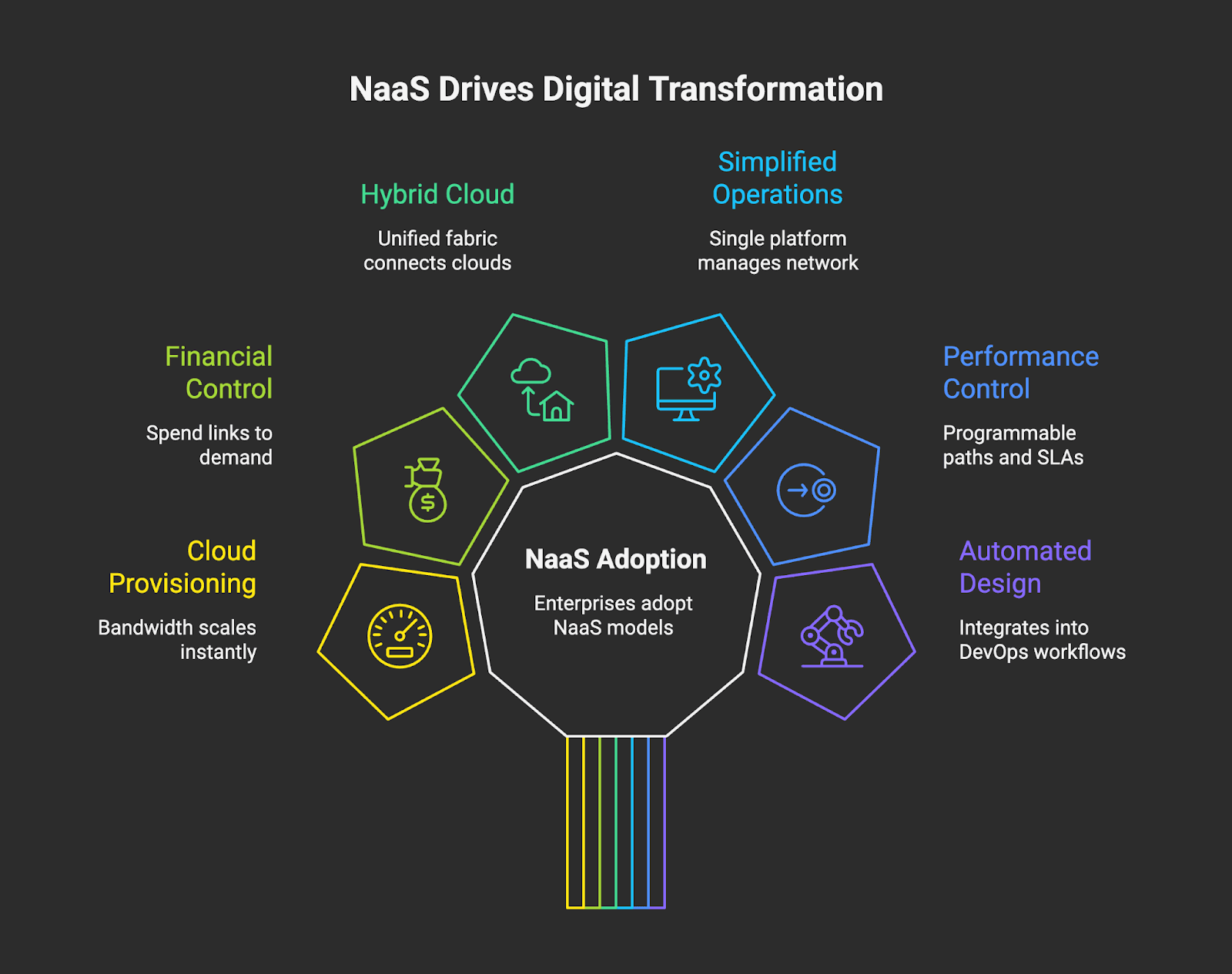
Cloud-Speed Provisioning
Weeks of provisioning now compress into minutes. Enterprises can instantly scale bandwidth for migrations, DR tests, AI model training, or seasonal surges, keeping business momentum uninterrupted.
Smarter Financial Control
Enterprises can no longer afford to lock capital into underutilized circuits. NaaS links network spend to actual usage , shifting heavy CapEx to flexible OpEx, reducing TCO and maximizing performance returns.
Built for Cloud and AI
As applications move across clouds and AI becomes more prominent in day-to-day business scenarios, NaaS provides a unified fabric that connects data centers, clouds, and edge compute corridors seamlessly. It supports low-latency east–west traffic, which maintains the flow of data packets, making workload placement a business decision, not a network limitation.
Simplified Operations
Everything from topology to network monitoring is managed through a single platform. Teams can adjust configurations or monitor performance without juggling multiple systems or raising endless tickets.
Performance You Can Shape
Software-defined paths, transparency, and SLA-backed performance give IT teams fine control. Latency-sensitive workloads get guaranteed performance, while less critical applications run cost-optimized routes.
Automated by Design
With automation, APIs and infrastructure-as-code, NaaS integrates directly into DevOps and IT workflows. Connectivity adjusts automatically to events, schedules, or policies, just like compute and storage.
Insight: Enterprises are embracing NaaS not as a trend but as a practical way to align networking with the pace of their business - fast, flexible, and measurable.
NaaS Use Cases with Tangible Gains: Where Connectivity Becomes a Service
Enterprises today manage data-heavy, latency-sensitive workloads across multiple clouds, regions, and data centers. As environments grow more distributed, the network must scale on demand, sustain predictable performance, and adapt in real time.
Here’s how NaaS is reshaping real enterprise scenarios, and where Polarin by Lightstorm has shown its strength in action:
Why Network-as-a-Service Pays Off for Modern Operations
Networks today are measured not by capacity but by how quickly they accelerate business outcomes. NaaS shifts networking from a rigid CapEx intensive utility to a strategic enabler, combining agility, visibility, and control that legacy architectures can’t deliver.
Accelerated Time-to-Market: Traditional provisioning typically takes months, but NaaS compresses this to minutes. According to a report by STL Partners, this agility allows enterprises to reach the market faster by eliminating legacy connectivity delays.
Drastic TCO Reduction: NaaS eliminates the "Stranded Bandwidth" tax by moving to a need-based, on-demand model. Customers report up to 50% TCO savings compared to static telco models.
Proven Return on Investment: A Forrester Total Economic Impact (TEI) study found that NaaS delivers a 174% ROI over three years, with a payback period of less than 6 months.
High-Performance Reliability: For the ~88% of organizations now utilizing AI in business functions, consistent performance is critical. NaaS provides 99.99% guaranteed uptime in metros and <1ms latency, ensuring mission-critical workloads bypass the unpredictability of the public internet.
Operational Excellence: Automated operations lead to fewer network incidents and an 85% reduction in incident resolution time according to Forrester TEI data.
Direct Cost Efficiency: Beyond general savings, private cloud on-ramps can cut cloud egress spend by 35-40% by avoiding high public internet egress bills.
Multi-Cloud Readiness: With ~89% of enterprises operating in a multi-cloud environment, NaaS provides a unified fabric to bridge disparate providers through a single, programmable interface.
Choosing the Right NaaS Partner – Key Factors to Consider
A successful NaaS strategy begins with the right partner, one that delivers speed, transparency, and reliability without hidden complexity. Use this checklist to evaluate if a platform truly supports your organization’s goals:
Checklist for Evaluation
- Confirm SLA-Backed Performance
Ensure the provider offers defined commitments for uptime, latency, and throughput so your critical workloads always run predictably.
- Review Global and Regional Reach
Check that the network extends across key data center hubs and cloud regions to support both local operations and global expansion.
- Verify Flexible Contracts and Pricing Models
Look for flexible contract terms and subscription or usage-based billing options that scale with business demand, keeping spends directly aligned with utilization.
- Ensure Deep Cloud and Data Center Integrations
The platform should connect natively with major cloud providers and data centers, simplifying hybrid and multi-cloud operations.
- Enable Real-Time Network Monitoring
Confirm you can monitor uptime, latency, jitter, packet loss ratio, and traffic in and out at circuit level in real time.
- Prioritize Security and Compliance
Evaluate encryption standards, role-based access, and certifications such as SOC 2, ISO 27001, or ISO 20000 to meet enterprise compliance needs.
- Check Compatibility with Existing Architecture
The NaaS solution should integrate smoothly with your existing network tools, SD-WAN, and IT management platforms without disruptive overhauls.
Insight: Assessing these factors ensures your enterprise invests in true cloud-grade networking rather than rebranded legacy services.
Polarin - Lightstorm’s true NaaS platform exemplifies this standard by combining SLA-backed reliability, global reach, security, and programmable APIs with real-time monitoring for complete network control.
The Future of Networking Is Software-Defined and On-Demand
Enterprise connectivity is evolving faster than ever. As data volumes surge and workloads expand across clouds, edge sites, and AI platforms, networks must adapt dynamically. Fixed-capacity models and manual provisioning can’t keep up with the pace of today’s AI era.
The future of enterprise networking is software-defined, agile, and delivered as a service, where security, control, scalability, and visibility are intrinsic, not add-ons. NaaS makes this possible by turning complex, hardware-bound infrastructure into an agile utility that responds in minutes.
With platforms like Polarin, enterprises are already experiencing this shift. High-performance networks are now activated in minutes, supporting data-intensive AI workloads and distributed cloud ecosystems with measurable performance and control.
See how Polarin brings cloud-speed agility to enterprise networking. Schedule a personalized session with our experts and explore what on-demand connectivity looks like.
FAQs About Network-as-a-Service (NaaS)
1. What is Network-as-a-Service (NaaS)?
Network-as-a-Service is a cloud-style model that delivers connectivity on demand. It allows enterprises to provision, scale, and monitor private networks in minutes through software rather than hardware.
2. How does NaaS differ from traditional networking?
Traditional networks rely on fixed circuits and long provisioning cycles. NaaS provides elastic bandwidth, SLA-backed performance, and software-defined control, aligning network delivery with the pace of modern workloads.
3.Why are enterprises moving towards NaaS?
Enterprises adopt NaaS to reduce provisioning delays, optimize costs, and improve visibility. With platforms like Polarin, they achieve agility and resilience for hybrid, multi-cloud, and AI-intensive operations.
4.How does Polarin support NaaS adoption?
Polarin delivers NaaS with <10-minute provisioning, Nx10G-100G scalability, and 100% metro uptime - all delivered automatically through a self-service portal with flexible contract terms, pay-as-you-go model, and on-demand bandwidth elasticity.