 Login for Polarin

The Network Behind AI
When people talk about AI, the conversation usually revolves around models, GPUs and data centres. Which model performs best? How much compute does it need? Which cloud platform offers the right environment to train and deploy it? These are important questions, but they focus on the most visible parts of AI while leaving the infrastructure that quietly makes it all possible in the background.
Every AI model depends on data moving continuously between data centers, cloud platforms, storage systems and users. Every training run, inference request and real-time AI application relies on a network that can move enormous volumes of data reliably and predictably.
As AI workloads become larger and more distributed, that network is no longer simply transporting information. Increasingly, it is determining how effectively AI itself performs.
For years, enterprise networks were built for applications with relatively predictable behaviour. If something went wrong, the network raised an alarm, engineers investigated the issue and service was restored. It was not instantaneous, but for most workloads, it was good enough. AI changes that equation.
When a distributed training workload slows down because data cannot move efficiently between GPU clusters, or when an inference service experiences latency because the underlying network is struggling to adapt, the impact is not measured only in downtime. It shows up as lost productivity, delayed insights and expensive compute sitting idle. In that sense, the network has quietly become part of the AI product.
That shift is becoming increasingly evident in our conversations at Lightstorm.
Enterprises, cloud providers and AI-driven businesses are no longer asking only about bandwidth or uptime.
They are asking whether their networks can keep pace with workloads that are dynamic, distributed and constantly evolving. They want infrastructure that does not simply recover when something goes wrong, but helps prevent disruption in the first place.
That is a very different conversation from the one the industry was having just a few years ago. It raises an important question: can networks built for yesterday's operating model support tomorrow's AI economy?
AI Is Changing the Rules for Networks
Every major technology shift has redefined what businesses expect from infrastructure. The internet made connectivity essential. Cloud computing made scalability non-negotiable. Streaming transformed latency from a technical metric into a customer experience issue. Now AI is raising the bar once again.
Unlike traditional enterprise applications, AI workloads rarely exist in one place. Training data moves across regions. Models interact with multiple data centres. Inference happens close to users, while orchestration may happen somewhere else entirely. The network is no longer connecting a handful of applications; it is coordinating an ecosystem of constantly moving intelligence.
That changes the role of connectivity itself. For decades, organisations have viewed networks as infrastructure that carries business applications. In the AI era, networks increasingly become participants in those applications. Their ability to adapt, recover and optimise in real time directly influences how AI systems perform.
This is why conversations around AI infrastructure can no longer stop at compute. Compute determines how much intelligence an organisation can create; the network determines how effectively that intelligence can move, collaborate and deliver value.
This marks one of the biggest shifts the networking industry has seen in decades. AI is not simply increasing demand for faster connectivity; it is changing what customers expect connectivity to do. Reliability is no longer enough. Networks must become more aware of their own health, more responsive to changing conditions and more capable of protecting customer experience without waiting for manual intervention.
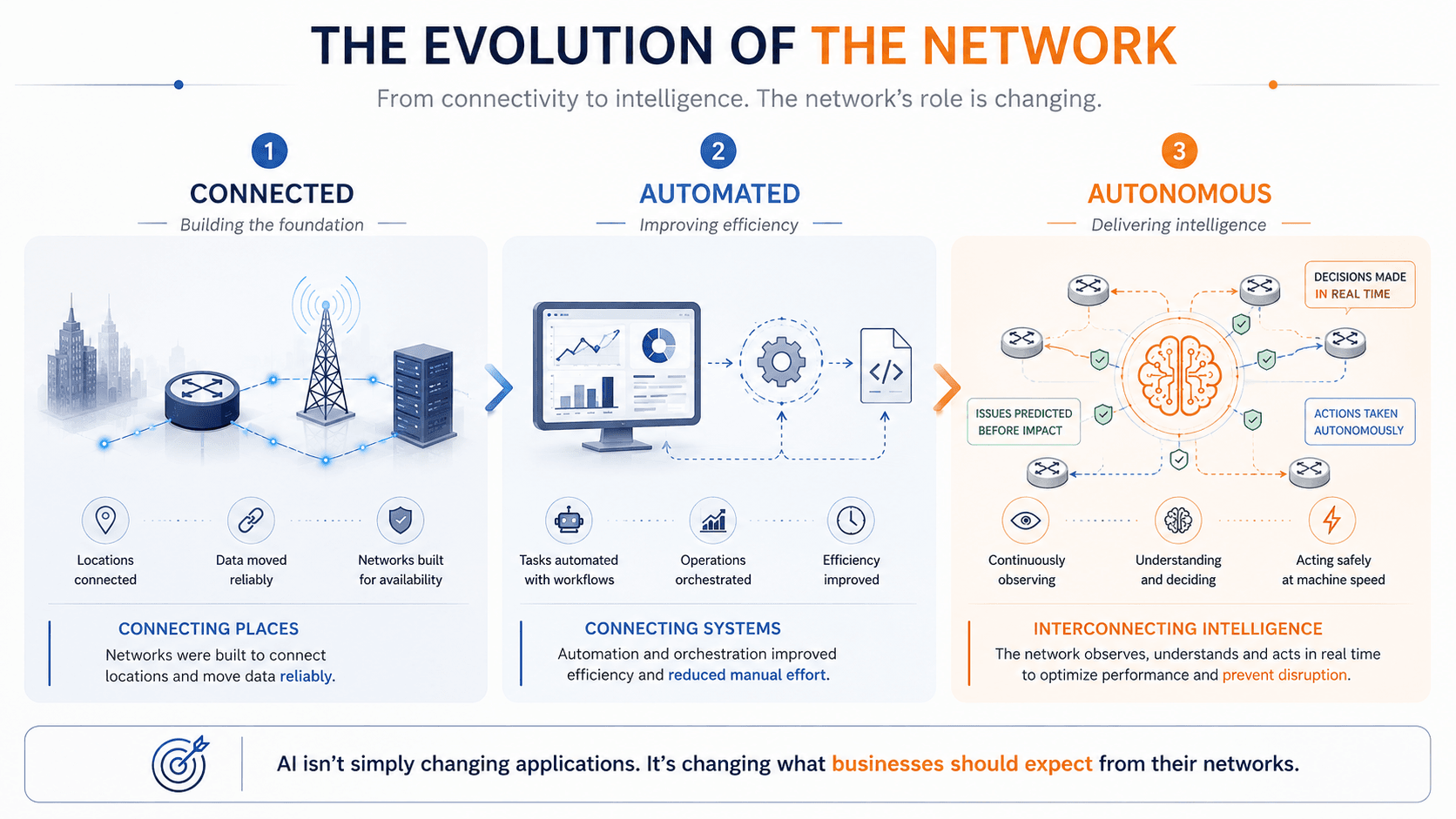
In many ways, AI is asking networks to evolve from passive infrastructure into active participants. That is where traditional operating models begin to show their limits.
Why Traditional Network Operations Are Reaching Their Limits
The challenge facing modern networks is not that they have become unreliable. In many ways, they have never been more capable.
Today's transport and IP networks generate an extraordinary amount of information about their own health. They can report changes in optical performance, monitor traffic flows, detect routing anomalies and identify early signs of degradation long before a customer notices anything is wrong. The irony is that, despite all this intelligence, most networks still rely on a decades-old operating model.
When an issue occurs, the network raises an alarm. Engineers investigate the incident, correlate information from different systems, determine the likely cause and decide on the safest response. It is a disciplined process that has served the industry well for years, but AI has changed the pace of the game.
Unlike traditional enterprise applications, AI workloads do not simply consume bandwidth. They depend on constant, predictable movement of data across distributed infrastructure. A brief interruption may delay thousands of GPUs working together on a training run. A momentary change in latency can affect real-time inference. What was once a minor operational event can quickly become a business event.
The network is not becoming harder to manage because engineers are less capable. It is becoming harder to manage because the volume of information now exceeds what even the most experienced operations teams can reasonably interpret in real time. That distinction matters.
For years, we have invested in making networks smarter by deploying better monitoring tools, richer analytics and more sophisticated management platforms. Yet the final decision in the operational chain has often remained the same: wait for a human to understand what is happening before the network responds. In the AI era, waiting is increasingly becoming the bottleneck.
That does not diminish the role of engineers. In fact, it elevates it.
The real opportunity is not to replace human expertise, but to stop asking humans to perform tasks that machines are now better equipped to handle.
Detecting patterns across millions of telemetry signals, correlating events happening simultaneously across multiple layers of the network and identifying emerging risks in seconds are problems AI is uniquely suited to solve. Human judgment remains indispensable, but it should not be spent chasing every alarm. It should be spent designing resilient networks, defining policies, managing exceptions and making strategic decisions that technology alone cannot.
From Reactive Networks to Autonomous Networks
For decades, the networking industry has measured success by one simple metric: how quickly can we recover when something goes wrong? It's a sensible goal, but it's built on an assumption that no longer holds true—that disruption is inevitable, and the best we can do is respond faster. AI challenges that assumption by asking a fundamentally different question: why should the customer experience the disruption in the first place?
That's the shift autonomous networks represent. They aren't simply faster at reacting; they're designed to anticipate. Rather than waiting for an engineer to investigate an alarm, an autonomous network continuously observes its own behaviour, recognises patterns that suggest something is beginning to drift, understands which services could be affected and evaluates the safest course of action before a minor issue becomes a customer-facing incident. Depending on the situation, that response may be as simple as notifying an engineer, rerouting traffic around a degrading path or restoring service automatically because the action has already been tested, approved and validated. The objective isn't to remove people from network operations—it's to remove unnecessary waiting.
That distinction becomes increasingly important as AI workloads grow larger and more distributed. Even small delays in operational decision-making can have consequences far beyond the network itself. A few seconds of hesitation may translate into idle GPUs, interrupted inference services or degraded customer experiences. In those environments, operational excellence is no longer measured only by how quickly engineers respond after something goes wrong. It is measured by how quickly the network can recognise a developing issue and make a safe, informed decision before customers feel the impact.
Far from making engineers less important, autonomous operations elevate their role. Instead of spending valuable time investigating routine events, engineers define policies, establish operational guardrails, validate automated actions and focus on the situations where human judgement genuinely adds value. That's a fundamentally different way of thinking about network operations—and one that better reflects the pace and complexity of the AI era.
The Network That Decides Before It Disrupts
At Lightstorm, we see this as more than another automation initiative. We see it as the next evolution of network operations. For years, automation has helped operators execute repetitive tasks more efficiently, but efficiency alone is no longer enough. AI workloads are inherently dynamic. Traffic patterns shift unexpectedly, infrastructure spans multiple clouds and data centres, and demand changes far more quickly than traditional operational processes were designed to handle. Responding effectively in that environment requires more than scripts and workflows; it requires systems that can understand context, interpret what they are seeing and act intelligently within clearly defined boundaries.
This is where technologies such as streaming telemetry and AI-driven analytics become foundational. Instead of relying on periodic snapshots of network health, autonomous operations are built on continuous visibility. The network is constantly observing itself, allowing emerging issues to be identified earlier, responses to be evaluated with greater confidence and customer impact to be reduced before it becomes visible. The result isn't simply a more automated network—it's a network capable of making better operational decisions because it has a richer and more timely understanding of its own condition.
Ultimately, autonomy isn't about building a network that operates without people. It's about building one that doesn't need to pause before protecting its customers.
In the AI era, the most valuable network won't necessarily be the one with the fastest links or the greatest capacity. It will be the one capable of making the right decision at exactly the right moment—quietly, safely and often before anyone even realises there was a problem to solve.