 Login for Polarin
The Four Horsemen of Modern Network Performance
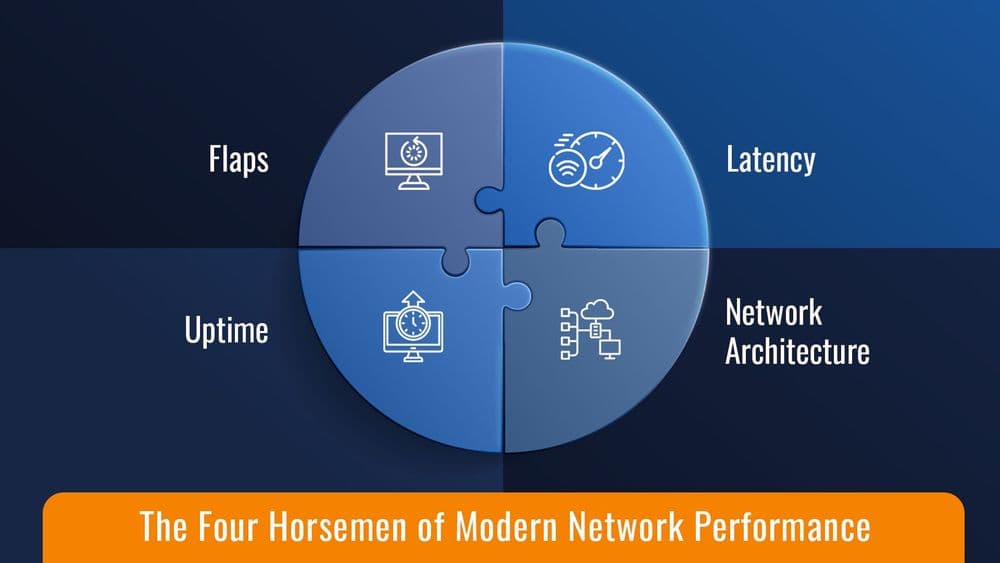
The key drivers behind your network (and your business)
Most enterprises still think about network performance in fairly narrow terms. Speed. Bandwidth. Maybe cost. But as businesses become more cloud-driven, more distributed, and more dependent on real-time systems, those old yardsticks start to fall short.
Modern digital platforms don’t run in one place anymore. They stretch across clouds, data centers, and regions, supporting everything from customer transactions to analytics and AI. In that environment, performance is shaped by a handful of forces working together. When any one of them is neglected, the cracks start to show.
These are the four horsemen of modern network performance.
Flaps - The Stability You Feel Before You See
Flaps happen when network links or routes repeatedly go up and down, sometimes for just a few seconds at a time. They often escape dashboards and alerts, yet their impact is very real.
Let’s take banking for example - This can surface as transactions that need to be retried or data that arrives out of sync. In SaaS platforms, background jobs may fail sporadically, and APIs become unpredictable. For streaming platforms and collaboration tools, users experience freezes, glitches, and sudden drops.
What makes flaps so damaging is how quietly they erode confidence. Systems appear online yet behave inconsistently. Over time, this unpredictability becomes just as disruptive as a full outage.
Customers adopting Lightstorm reported both a reduction in incident frequency and faster incident resolution, cutting both the number and duration of disruptions that “hide in plain sight.”
Latency - The Pace of Digital Experience
Latency is the time it takes for data to move between two points. As applications become more interactive and more globally distributed, that travel time starts to define how usable a system feels.
For example, in e-commerce, latency shows up in page loads and checkout flows. In financial platforms, it affects real-time pricing and risk decisions. In AI and analytics, it influences how quickly models can respond and how smoothly data pipelines run.
Even small delays compound across multiple services and regions. When everything depends on everything else, responsiveness becomes a core part of the user experience.
Uptime. The Reliability People Expect Without Thinking About It
Uptime is the foundation of every digital business. Customers assume services will be available. Teams expect tools to work when they need them. Partners rely on systems being reachable.
For logistics firms, uptime keeps shipments moving. For IT services providers, it keeps SLAs intact. For consumer platforms, it keeps users engaged. The moment availability slips, the impact is immediate and visible.
Yet uptime by itself is only part of the story. Reliability also depends on how consistently the network performs under load, across regions, and during peak demand.
At this level, every additional decimal point of uptime is practically worth its weight in gold, and not because it sounds impressive on a dashboard, but because it quietly removes hours of risk from the business.
In fact, a Forrester TEI study found that a composite enterprise improved SLA from 99.5% to 99.99% with Lightstorm, helping prevent ~$1.1M in revenue loss over three years.
Network Architecture: Connecting Distributed Workloads the Right Way
Modern enterprises no longer operate from a single data center or a single cloud. Workloads are spread across multiple clouds, regions, and data centers, often running simultaneously.
This makes network architecture — how endpoints like data centers, cloud regions, and application environments are interconnected — a critical factor in overall performance.
When the underlying architecture is not designed for distributed environments, traffic may take inefficient paths between clouds, DCs, and users, leading to unnecessary latency, instability, and inconsistent application behavior.
In manufacturing, this can slow down data flowing from plants to analytics systems. In SaaS, it can make applications feel sluggish in certain regions. In AI workloads, it can stretch out inference and synchronization.
As workloads become more distributed, network architecture directly determines how efficiently endpoints communicate across clouds, data centers, and regions.
It is no longer just about being connected — it is about being architected to connect the right endpoints through optimized, predictable paths.
Why These Four Horsemen Shape Everything
Flaps, latency, uptime, and network architecture don’t operate in isolation. They influence each other in subtle ways.
A low-latency link loses value if the architecture routes traffic inefficiently across regions. High uptime cannot compensate for poorly designed interconnections between clouds and data centers. Strong stability alone is not enough if the underlying architecture cannot support distributed workloads.
Strong network performance comes from balance across all four.
When any one of these breaks, the network feels fragile. When all four work together, performance stops being a bottleneck and starts behaving like dependable infrastructure.
The Business Impact of Modern Network Performance in 2025
As businesses continue to adopt cloud, AI, and distributed platforms, networks are no longer just background infrastructure. They directly shape customer experience, operational efficiency, and the ability to move quickly.
The most useful questions now sound less like “How fast is our network?” and more like:
How stable is our network when demand spikes?
How consistent is network performance across regions and clouds?
How easily can our network adapt to change?
How intelligently does network connect us to where our data and applications actually live?
Those answers determine whether the network supports growth or quietly slows it down.
What Enterprises Can Do to Improve Network Performance Today?
Understanding flaps, latency, uptime, and network architecture is only half the battle. The real value comes from acting on that insight. Enterprises that want to stay ahead in 2025 can start with a few practical steps:
Audit network stability and latency across regions. Look beyond simple uptime numbers and examine how often links fluctuate or performance degrades during peak usage.
Map application dependencies. Identify where your applications, data, and users are located, and how traffic flows between them. This makes it easier to spot inefficient routes and hidden bottlenecks.
Align network KPIs with business outcomes. Measure what actually impacts revenue, customer experience, and productivity, not just raw bandwidth or link availability.
These steps create a baseline for understanding how well your current network supports what your business is trying to do.
How Lightstorm Reins in the Four Horsemen
Every enterprise faces the same four forces. What separates high-performing networks from fragile ones is how those forces are handled. Here’s how Lightstorm turns them into advantages:
Flaps: Automated failover and proactive monitoring keep traffic flowing even when parts of the network experience instability.
Latency: Direct connectivity to clouds and data centers, combined with intelligent routing, keeps applications responsive wherever users are.
Uptime: Built-in resilience and disaster recovery capabilities ensure that critical systems stay available, even during failures.
Network Architecture: Designed for distributed environments in the AI era, enabling efficient interconnection between data centers, cloud regions, and enterprise endpoints without suboptimal routing.
Instead of fighting these challenges reactively, Lightstorm’s approach allows enterprises to run their networks with confidence, knowing performance, stability, and reach are built into the foundation.
The Bottom Line
The four horsemen (of network performance) are not problems to be feared. They’re indicators that reveal how ready a network really is for modern digital business.
When stability, responsiveness, availability, and intelligent connectivity come together, the network stops being a constraint and starts becoming an advantage.
That’s what modern network performance looks like.
Sidhant Shori
Manager - Brand & Product Content