
Why Connectivity ROI Is Finally Measurable
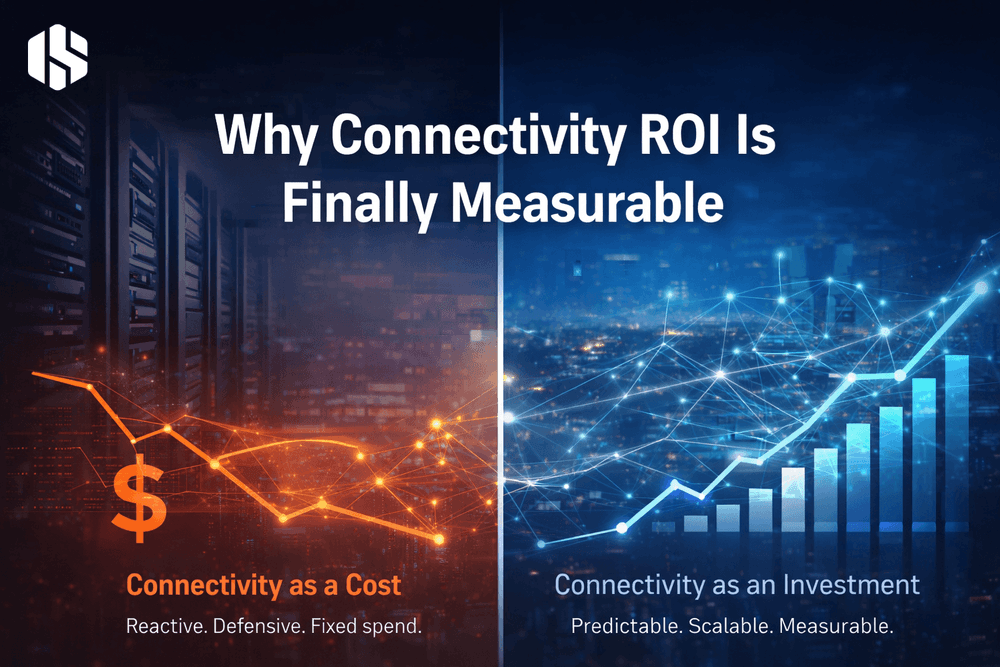
For decades, connectivity investments have lived in an uncomfortable space.
They are critical to almost every modern business outcome, yet they are rarely discussed in the same language as revenue, efficiency, or return on investment. Networks have traditionally been evaluated through technical metrics like uptime, latency, and bandwidth utilisation, while business cases rely on assumptions, proxies, or worst-case scenarios.
This gap has made connectivity one of the hardest parts of enterprise infrastructure to justify economically, even as its importance has only grown.
That is beginning to change - Recent shifts in how networks are built, consumed, and operated are making it possible to connect network performance directly to business impact. The Forrester Total Economic Impact™ study on Lightstorm offers a useful lens into why connectivity ROI is now measurable in ways it was not before.
Why Connectivity was Rarely Measured for ROI
Traditional connectivity models were not built with an expectation of economic return.
For most enterprises, connectivity was treated as a foundational necessity rather than an investment expected to generate value. Fixed contracts, long provisioning cycles, and rigid architectures meant networks were sized for peak demand and then left largely unchanged. This mindset reduced networks to a necessary evil, overlooking their potential as a catalyst for innovation and efficiency. The primary goal turned into stability and risk avoidance, not optimization or measurable upside.
When performance issues occurred, they were accepted as operational realities of running complex networks. Downtime was acknowledged, and in many cases its cost was estimated through SLA penalties or post-incident analysis, but it was rarely used to inform how connectivity spend itself should be evaluated or improved. Overprovisioning was a deliberate hedge against failure, seen as the price of reliability rather than an inefficiency to be addressed.
In this environment, connectivity spend was justified because it was essential to keep the business running. ROI was not the central question. Networks were managed as cost centers, with losses from downtime viewed as something to be minimized, not as an opportunity to rethink how connectivity investments could deliver measurable returns.
What Changed in the Modern Connectivity Model
Modern enterprise networks look very different.
Hybrid and multi-cloud architectures have increased the number of applications, users, and data flows that depend on reliable, low-latency connectivity. At the same time, digital services have become directly tied to revenue, customer experience, and regulatory commitments.
As a result, network performance is no longer abstract. When connectivity falters, the impact shows up immediately in transaction failures, degraded customer journeys, delayed onboarding, and compliance risk.
Equally important, modern network platforms have introduced new operating models. On-demand capacity, self-service provisioning, and real-time visibility have changed how networks are consumed and managed. These changes create observable differences in how incidents occur, how quickly services are delivered, and how resources are allocated.
This combination of increased dependency and improved operational control is what makes measurement possible.
From Multi-Year Justifications to Months
In Forrester Consulting’s Total Economic Impact™ study for Lightstorm, the composite organization achieved payback in under six months. This means the economic benefits associated with improved availability, reduced operational friction, and greater efficiency exceeded the cost of the investment faster than many traditional infrastructure initiatives.
For connectivity investments that are often justified over multi-year horizons, this represents a meaningful shift in how quickly value can be realized.
From Technical Metrics to Economic Outcomes
The Forrester Total Economic Impact™ framework approaches connectivity from a different angle. Instead of asking whether a network is faster or more flexible, it asks how changes in network performance affect outcomes that matter to the business.
In the Lightstorm study, Forrester examined three broad areas where this connection became visible.
First, service availability. Improvements in uptime were not treated as abstract percentages. They were tied directly to safeguarded operating income by analysing how downtime affected customer-facing services.
Second, incident management. Reductions in the frequency and duration of incidents translated into measurable productivity gains for network operations teams, freeing time that would otherwise be spent firefighting.
Third, cost efficiency. Shifting from rigid contracts to flexible consumption reduced overprovisioning and improved cost predictability, creating tangible savings over time.
174% return on investment over three years
Across these areas, Forrester’s analysis calculated a risk-adjusted return on investment of 174% over a three-year period. This figure reflects the combined effect of improved service availability, more efficient incident management, and optimized networking costs.
Importantly, this return is not driven by a single factor, but by the compounding impact of multiple operational improvements working together.
Why This Matters Now
The ability to measure connectivity ROI arrives at a critical moment.
Enterprises are under increasing pressure to justify infrastructure investments not just to IT stakeholders, but to finance teams, boards, and executive leadership. At the same time, networks are expected to support more dynamic workloads, stricter compliance requirements, and higher customer expectations than ever before.
In this context, “connectivity as a necessity” is no longer a sufficient argument. Leaders need to understand what they are getting in return, how quickly value is realized, and where risks are reduced.
$1.2 million in quantified benefits versus $425,000 in costs
In the Forrester study, the composite organization realized approximately $1.2 million in quantified benefits over three years, compared to total costs of around $425,000. This comparison underpins the net present value and return on investment calculations and highlights the scale of impact relative to investment.
For decision makers, this level of transparency is critical. It allows connectivity investments to be evaluated alongside other strategic initiatives using familiar financial frameworks.
What “Measurable” Really Means for Connectivity
When we say connectivity ROI is finally measurable, we do not mean that networks have become simple or that uncertainty has disappeared.
What has changed is the ability to link cause and effect.
Improvements in availability can now be tied to revenue protection. Reductions in operational friction can be connected to productivity gains. Flexibility in consumption can be reflected in cost efficiency and predictability.
This shift allows connectivity to be discussed in the same language as other business investments, without reducing it to a purely financial exercise.
Looking Ahead
As enterprises continue to modernize their infrastructure, the conversation around connectivity will continue to evolve.
The question will no longer be whether networks are fast enough or flexible enough in isolation. It will be how network decisions shape business outcomes over time, and how quickly value is realised.
The Forrester Total Economic Impact™ study on Lightstorm offers one example of how this conversation can be grounded in evidence rather than assumption.
For the first time, connectivity is not just essential. It is explainable, defensible, and measurable.
To read the complete Forrester study, Click Here.